Short answer: begin with the pressure specified by the trailer or vehicle manufacturer on the certification/tire-information label and in the owner’s manual, measured when the tires are cold. The pressure molded on a tire sidewall is not a universal recommendation for every trailer; it identifies the tire’s rating conditions. If your installed tires, wheels or placard do not agree, stop and verify the setup with the trailer, tire or wheel manufacturer or a qualified tire professional.
This question keeps appearing in current RV conversations. Recent travel-trailer tire-pressure discussions show owners comparing placards, sidewalls and load charts, while another PSI thread illustrates how quickly advice becomes contradictory when trailer weight, tire construction and wheel ratings are left out.
Two trailers that look similar can have different axle loads, tire sizes, load ranges, wheels and manufacturer requirements. Do not copy another owner’s pressure setting without matching the complete equipment and loading context.
What the trailer placard tells you
The trailer certification or tire-information label typically identifies the original tire size and the recommended cold inflation pressure for the manufacturer’s specified loading. That makes it the primary starting point for an unmodified trailer. The owner’s manual may add instructions for checking pressure, loading and replacement tires.
What the tire sidewall number means
A sidewall marking communicates the tire’s size, load rating and pressure associated with its rated capacity. It is not permission to exceed the trailer, wheel or component limits, and it does not automatically replace the vehicle placard. When replacement tires differ from the original specification, all ratings and manufacturer instructions must be reconciled.
When a load-and-inflation chart matters
A tire manufacturer’s load-and-inflation table can help qualified owners or professionals evaluate a known, measured load for a specific tire. It only works when the exact tire type and actual wheel-position or axle loads are known. Guessing the loaded weight or using a chart for a similar tire is not enough.
- Weigh the fully loaded trailer in travel condition, including water and cargo.
- Use the chart published for the exact tire size and construction.
- Respect the trailer, axle, tire and wheel ratings—the lowest applicable limit still controls.
- Allow for side-to-side load differences instead of assuming every tire carries the same weight.
- Have modifications reviewed when the replacement specification differs from the placard.
Why “cold” tire pressure matters
NHTSA tire guidance recommends checking tires when cold and using the vehicle manufacturer’s recommended pressure. “Cold” generally means before the day’s driving, after the vehicle has been parked long enough for the tires to cool. Pressure normally rises as tires warm in use.
Do not automatically bleed air from a warm tire to return it to the cold specification. Doing so can leave the tire underinflated after it cools. If a warm reading is unexpectedly high or one tire differs sharply from comparable tires, stop safely and investigate the cause.
What an RV TPMS adds after departure
A manual gauge confirms the starting pressure; a tire pressure monitoring system watches for change during the trip. It can alert you to a slow leak, rapid loss, abnormal temperature or a missing sensor signal. That live information is especially useful on a trailer because the driver may not feel a tire problem immediately.
Owners in a recent r/RVLiving TPMS discussion compared displays and alert behavior. Their experiences are useful context, but they do not replace the setup instructions for your tires and TPMS.
A repeatable tire routine for towing days
- Inspect before moving. Look for cuts, bulges, cracking, objects, uneven wear and damaged valve stems.
- Measure cold pressure. Use a reliable hand gauge and compare with the trailer specification.
- Check the spare. A flat or incompatible spare is not a backup.
- Confirm the load. Keep cargo and tongue weight within all applicable ratings.
- Verify every TPMS sensor. Confirm position, pressure, temperature and battery status before departure.
- Pause after the first miles. At a safe stop, walk around and look for heat, odor, looseness or visible changes.
- Respond to trends. One tire losing pressure or heating differently deserves inspection even before an alarm.
Common tire-pressure mistakes
- Using the passenger-car door placard for the trailer tires.
- Treating the sidewall maximum as a universal setting without checking the trailer specification.
- Checking only after driving, then bleeding warm tires.
- Assuming all tires on an axle carry identical loads.
- Ignoring wheel pressure ratings or aged valve stems.
- Relying on TPMS instead of physical inspections and a hand gauge.
Where the AOMOSUR AM100 fits
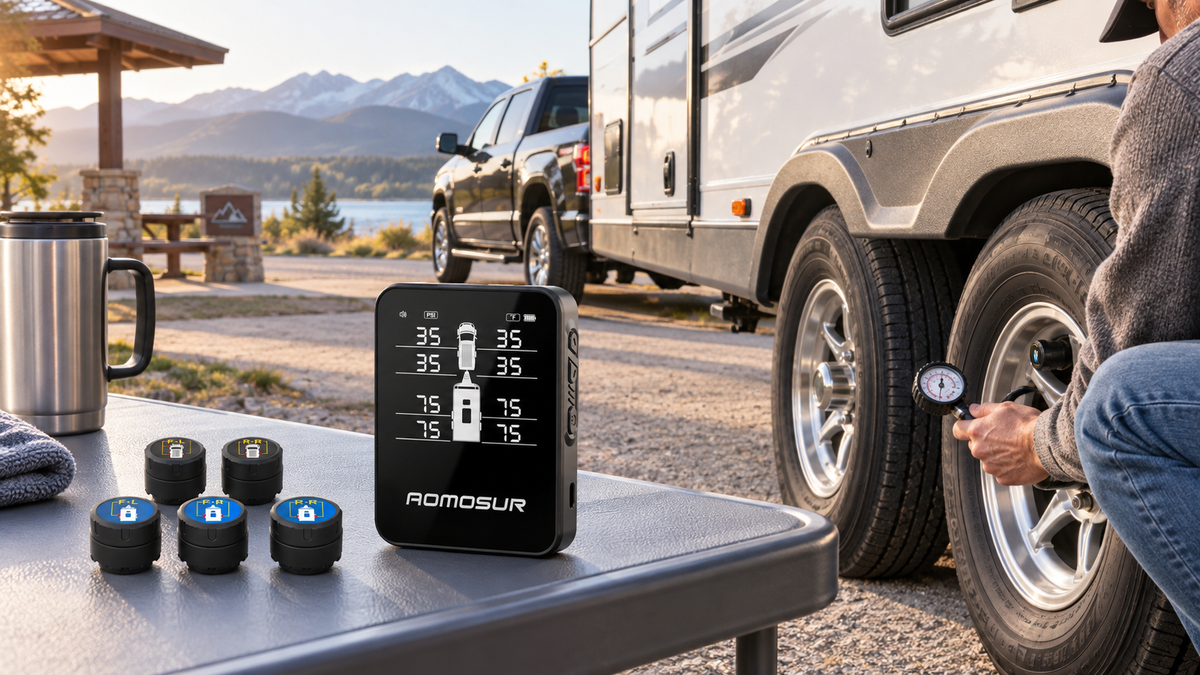
The AOMOSUR AM100 Wireless RV TPMS uses external sensors and a dedicated color display to show real-time pressure and temperature. Choose the sensor configuration that matches the number of tires you intend to monitor and follow the installation and alarm-setting instructions.
Frequently asked questions
Should trailer tires always be inflated to the sidewall maximum?
Not as a blanket rule. Start with the trailer manufacturer’s label and manual. If tire, wheel or replacement specifications differ, obtain guidance specific to the complete setup.
How much should tire pressure rise while towing?
Pressure rises with heat, load and speed, so there is no single universal increase. Watch for alarms and meaningful differences among comparable tires rather than chasing an exact warm number.
Do I need a hand gauge if I have TPMS?
Yes. Use a reliable gauge for cold setup and verification. TPMS is best used for continuous monitoring after departure.
Should I include the spare in my TPMS?
Monitoring the spare can be useful if the system supports it, but manually inspect and check the spare regularly in any case.
Next step: View the AOMOSUR AM100 or browse Tire Monitoring Systems.